Why a Coastal Court Can Feel More Exposed
A coastal court can feel more exposed than an inland one. Learn to read shelter, orientation and landforms to understand the space around the court.
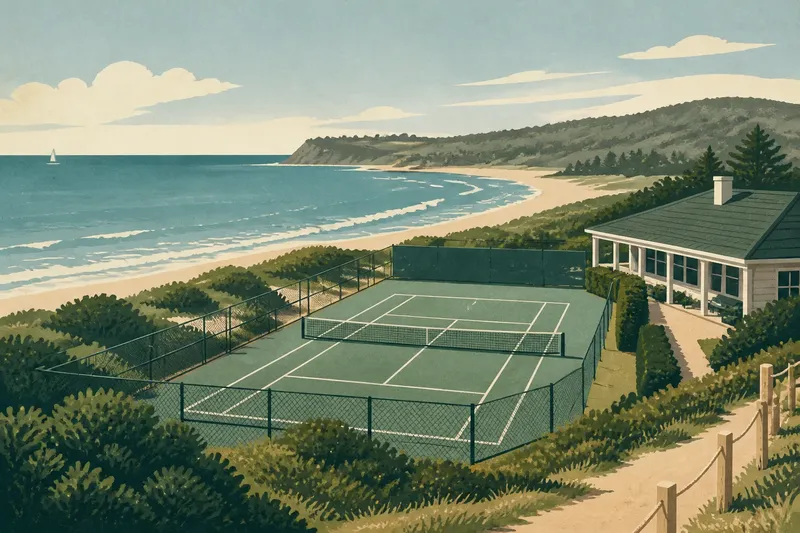
The most common mistake when judging a coastal court is to treat its open view as proof that the whole setting is open. A coastal court can feel more exposed than an inland one even when a fence, clubhouse or low rise sits nearby, because the shoreline changes how shelter and distance register. The view may stretch to the horizon while the court itself sits in a hollow, behind a dune or under the lee of a headland.
To understand that difference, look beyond the playing surface. Notice what interrupts the view, what runs alongside the court and what lies behind it. These details are not playing advice; they are a way to read the setting as a place. Three useful approaches are to start with the horizon, trace the edges around the court, or compare the court with the land immediately behind it. Each suits a different kind of visit.
Start with the horizon to read openness
A clear horizon can make a court seem unusually exposed, especially where a broad stretch of water occupies one side of the view. The eye has few nearby features to settle on. By contrast, a low ridge, wooded point or built-up shoreline creates a visual boundary, even if it does little to enclose the court itself.
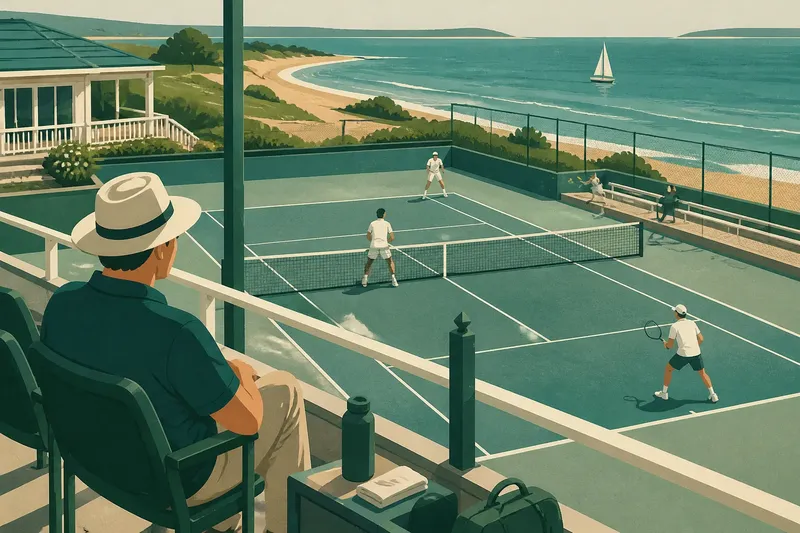
From a public path or viewing area, pause where you can see both the court and the water. Ask how much of the court’s surroundings remain visible beyond its boundary. A beach that continues past the fence, a long line of open sea, or a distant headland with little in between can make the court feel like a small, distinct object within a much larger landscape.
This approach suits a first-time visitor trying to understand why a venue feels different from an inland park court. It is also useful for describing the place to someone who has not visited. “The court faces a long, unbroken horizon” tells more about the setting than simply calling it scenic.
There is no need to seek a panoramic viewpoint or walk far from the public route. That effort is not worthwhile if the court’s relationship to the horizon is already clear from the entrance or spectator area. The point is to notice the scale of the view, not to find the most dramatic angle.
Trace the court’s edges to find local shelter
A shoreline court may look open from one end and enclosed from another. A clubhouse can block the view behind a baseline. A row of shrubs may screen the side nearest the road, while a low fence leaves the sea-facing edge visually open. Nets, fences and buildings define the court’s immediate outline, but nearby features also affect how contained it appears.
Walk around only where access is public and permitted. Look for the height and continuity of the features around the court. A solid wall gives a stronger sense of enclosure than a mesh fence. A hedge with gaps frames the view without closing it. A beach berm or dune may hide the lower part of the landscape while leaving sky and water visible above.
These observations distinguish physical shelter from visual shelter. A building can conceal a large part of the surrounding landscape, making the court feel tucked in, even if the view opens up at one end. A thin fence can mark a firm boundary without reducing the sense of exposure at all.
This method suits people choosing where to watch or meet someone. A spectator who prefers a defined, close setting may find the side beside a clubhouse more comfortable than the end facing open water. Someone who enjoys a broad view may prefer the opposite side. The preference is about the feel of the place, not a promise about comfort or playing conditions.
Compare orientation with the land behind the court
Orientation describes how the court sits in relation to the shoreline and nearby terrain. A court may run parallel to the coast, point toward the water, or sit at an angle between the two. Those arrangements change which features dominate from each end and how much land appears to frame the court.
Look for a simple relationship rather than trying to infer technical design choices. If the long side of the court follows the coast, the water may remain in a side view. If an end points toward the sea, the horizon may become the strongest feature from that end. A court set behind a headland or between dunes may present a much more enclosed view, despite being close to the shoreline.
Nearby landforms can also make two courts at the same venue feel unlike each other. A low dune may screen the lower landscape from one court. A rocky point may interrupt the horizon from another. A row of trees or a bluff can give one side a visual backstop while the other appears to open directly into the coastal landscape.
Say you arrive at a club with two public courts. One sits beside a low dune, with a clubhouse visible beyond one end; the other has a clear view across the water from its long side. If your goal is to watch the surroundings feel close and defined, the first court may suit you. If you want a stronger sense of openness, the second may be the better choice. The visible differences, not assumptions about play, provide a practical basis for choosing.
Choose the approach that matches your visit
These three ways of looking answer different questions. Use the horizon when you want to judge the scale of the setting. Trace the edges when you want to know whether the court feels visually enclosed. Compare orientation and landforms when two courts or two viewing spots seem different despite sharing the same coastline.
A quick visit can follow a few concrete prompts:
- Check the horizon: Is open water visible beyond the court, or does a headland, building or tree line interrupt it? Choose the view that suits how much visual openness you want.
- Check the boundary: Is the nearest edge a solid wall, a hedge, a dune or a see-through fence? Decide whether a defined backdrop or an uninterrupted outlook feels more appealing.
- Check what lies behind each end: Note whether the court faces water, a building, a path or rising land. Use that difference to pick a viewing side.
- Check the side views: See whether the coast runs alongside the court or appears mainly from one end. Choose a spot with the relationship to the shoreline you most want to notice.
- Check the landforms: Look for dunes, bluffs, rocky points and tree-covered rises. Decide whether their framing makes the setting feel sheltered, open or somewhere between.
When access is limited, use only the views available from public paths and permitted areas. A gate, fence or marked boundary is a reason to stay on the visitor side; there is no need to enter a restricted area to read the landscape.
Why does the same court feel different from each end?
Each end points the eye toward a different set of features. One may face a clubhouse or rise in the land, while the other looks toward water and open sky. That change in visual background can alter the sense of enclosure without changing the court itself.
Does a nearby dune make a court feel sheltered?
A dune can screen part of the surrounding landscape and create a stronger sense of a boundary. Its effect depends on its position and shape; a low or distant dune may frame the view without making the court seem enclosed.
What should I notice about a sea-facing court?
Look at whether the water fills a side view or sits directly beyond an end, and note what interrupts the horizon. A clear view can make the surroundings feel broad, while nearby landforms or buildings give the scene a closer frame.
Can two courts at one seaside venue feel unlike each other?
Yes. Their orientation, nearby buildings, vegetation and landforms can create different views and different degrees of visual enclosure. Compare those features from public areas rather than assuming that courts close together share the same feel.
A coastal court feels exposed for more than one reason: the horizon may be wide, its edges may offer little visual cover, or the surrounding land may fall away from the site. The simplest way to read it is to compare what you see beyond the court on each side. That small habit makes “open,” “sheltered” and “in between” useful descriptions of a particular place, rather than labels applied to every court by the sea.